
There’s only one thing you can guarantee in the Podcasting Industry: change. Changes to the roles we see, the shows we create and how we communicate with our audiences. 2025 has been a massive year for change, and Richard Clark was right on the money.
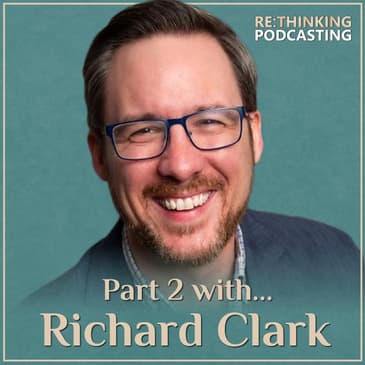
This week I’m joined, once again, by Richard Clark: Founder & Owner of Area Code Audio based in Chicago to cover his predictions made at the beginning of this year for how podcasting was going to change in his Podcasting For Humans newsletter.
You were introduced to Richard in last week’s episode, in addition to finding out about his newsletter efforts and the first two of his main predictions for 2025. This is Part 2 of that conversation, so if you’d like to fill in the blanks, scroll up the Rethinking Podcasting feed and listen to Part 1 first.
In this episode, we’ll round off our discussion about human connection and tackle three big predictions Richard made about big funding for podcasts, companies creating their own engaging shows, and the marketing spend moving from social media to newsletters and podcasts. There’s a lot here to chew on, and there’s so much that he got right, that it’s well worth the listen.
What I picked up from this chat with Richard is that engagement and investment are the two major things changing this year. As podcasters, we get swept up in the short-term pivots and growth hacks, but keeping an eye on the long-term affectations on the industry will help you build your sustainable goals for your show.
Resources Mentioned in this Episode:
Get in touch with Richard:
Let's Start a Dialogue
The Socratic Method is best done in dialogue, so if you'd like to respond to one of my episodes or send through an idea of your own, send it to:
📧 podcast@rethinkingpodcasting.com
🎤 rethinkingpodcasting.com and select "Send a Voicemail"
Make sure you share the name of your show, so I can include it in my response!
Support this Podcast:
Here are some of the services I use to create this show. Sign up for these services with the links below to support the podcast:
Use Brain.FM to stay focused while you podcast (30 Day Free Trial)
Sign up for Artlist.io to add Royalty Free Music to your Podcast (2 Months Free)
Use Captivate.FM to host & distribute your Podcast (30 Day Free Trial)
Create your Episode Transcript with GoodTape.io (€5 off when you sign up)
Chapters:
- (00:00) Change as the Only Constant in Podcasting
- (01:10) Predictions for 2025: Engagement and Investment
- (02:09) Parasocial Relationships in Podcasting
- (04:11) When Trust Breaks Between Podcasters and Listeners
- (06:14) Consistency, Growth, and the Friendship Analogy
- (06:44) Independent Podcasts Rising After Big Studio Cuts
- (09:23) Sustainability Over Profit in Podcasting
- (13:11) Why Every Podcast Needs Resources to Survive
- (14:28) Branded Podcasts Done Well (and Done Wrong)
- (16:33) Aligning Brands, Hosts, and Values
- (19:11) Marketing Dollars Shift to Newsletters and Podcasts
- (28:41) Final Reflections and Richard’s Work at Area Code Audio
This podcast uses the following third-party services for analysis:
OP3 - https://op3.dev/privacy
There's only one thing you can guarantee in the podcasting industry, change.
Speaker:Changes to the roles we see, the shows we create, and how we communicate with our
Speaker:2025 has been a massive year for change, and Richard Clark was right on the money.
Speaker:Welcome back to Rethinking Podcasting, where I take a Socratic approach to reflect
Speaker:podcasting world and help you build your own podcast philosophy.
Speaker:I'm Matthew Bliss, and this week I'm joined once again by Richard Clark,
Speaker:founder and owner of Area Code Audio based in Chicago, to cover his predictions made
Speaker:at the beginning of this year for how podcasting was going to change in his
Speaker:Humans newsletter. You were introduced to Richard in last week's episode. In addition
Speaker:to finding out about his newsletter efforts and the first two of his main predictions
Speaker:for 2025, this is part two of that conversation. So if you'd like to fill in
Speaker:In this episode, though, we'll round off our discussion about human connection and
Speaker:There's a lot here to chew on, and there's so much that he got right
Speaker:that it's well worth the listen. What I picked up from this chat with Richard is
Speaker:and investment are the two major things changing this year. As podcasters, we get
Speaker:short-term pivots and growth hacks, but keeping an eye on the long-term affectations
Speaker:will help you build your sustainable goals for your show. All right,
Speaker:enough lily gilding. Let's finish off my chat with Richard Clark.
Speaker:Would you say that people see podcasters as friends or even podcasts as friends in that
Speaker:Yes.
Speaker:Or is it just seeking the space?
Speaker:I use the analogy.
Speaker:I mean, not literally, hopefully, but.
Speaker:Yeah, it's like a parasocial relationship, but they're seeking a relationship with
Speaker:they agree with that makes them feel good and gives them what
Speaker:they want from a distant relationship.
Speaker:You know, I think a lot about parasocial relationships because it certainly is a
Speaker:with podcasting.
Speaker:But for podcasting, it feels almost positive.
Speaker:There are certain podcasters I've heard talk about the need to set up boundaries,
Speaker:think that's extremely important and fair.
Speaker:But for the most part, when I hear podcasters talk about the relationship they
Speaker:their audience, they talk about
Speaker:it typically in a positive way.
Speaker:And here is why I think that is the case.
Speaker:When you have a parasocial relationship with a superstar, with a celebrity, you are
Speaker:stuff onto them.
Speaker:People constantly are guessing, assuming, projecting their hopes and dreams onto this
Speaker:person.
Speaker:It is alienating for that person.
Speaker:That is, you encounter someone who loves you so deeply but they do not know who you
Speaker:are that is not a good feeling when you listen to a podcast not completely but to a
Speaker:amount to the degree to which that podcast is any good they're going to know somewhat
Speaker:on a real realer level these are all degrees so it's still a mediated
Speaker:sweet spot where they're not having to have those uncomfortable conversations.
Speaker:They're not having to step on your toes in various ways.
Speaker:They're not like getting invites to hang out, but then going to doing another
Speaker:thing when they told you they weren't available, that stuff is not happening.
Speaker:Yeah.
Speaker:The friends can't cheat on you when they're just in your RSS feed.
Speaker:They can, you just tap in when you're ready.
Speaker:There are ways to betray those people.
Speaker:And I've experienced that.
Speaker:Like that is a hard feeling actually to like follow a podcaster and then they just
Speaker:mess up in a way that, I mean, I'm going to name names here, the reply all situation.
Speaker:I don't know if anyone's, this audience may be familiar with that, but when reply all
Speaker:sort of flamed out and that the stuff that came to light there really disappointed me
Speaker:and put me off of reply all.
Speaker:I mean, I like one of those guys, but the other guy I kind of
Speaker:can't listen to is extremely popular podcast at this point because of the way
Speaker:that went down and the way that that was handled.
Speaker:So that is real, but fundamentally, I think we have these parasocial
Speaker:relationships with people that are at least positive, if not healthy.
Speaker:I don't know if they're healthy.
Speaker:That's a big question.
Speaker:But I do think they're positive in general, in nature until they go off the rails a
Speaker:can feel weird i think that kind of really un unfortunate kind of parasocial activation
Speaker:call it uh kind of happens at the the millions of downloads per month mark true uh
Speaker:i can't even name a few but the very least like stephen bartlett gets a crosshair on
Speaker:because he had a couple of people who talk about fasting for 14 days being a great
Speaker:lifespan by 20 years. And, uh, all of a sudden fact checking becomes a big issue for
Speaker:But you know, he's got enough spread and people are aware of him that it becomes an
Speaker:that. Right. Uh, but I think you're right. I think you're right. Like it's, it's more
Speaker:voyeur of a conversation that people are inviting you to listen to. I use friendship
Speaker:as a metaphor or, or sort of an analog a lot with people when I'm talking
Speaker:to them about how to make podcasts and examples are like, okay, like they ask
Speaker:about consistency, well, if you want a really deep relationship, the more
Speaker:often they see you, the better, but it's better not to be flaky.
Speaker:So if you're gonna say you're every week, you gotta be every week.
Speaker:Cause that friend who just doesn't show up at the thing is very annoying and you
Speaker:start to sort of lose trust in them.
Speaker:But if you're meeting for a friend every week for coffee, every day for coffee, like,
Speaker:that's going to be a really deep relationship.
Speaker:You just have to pull it off.
Speaker:That's all.
Speaker:Yeah.
Speaker:I like that too, because it correlates to growth.
Speaker:Like if you imagine you've got a big circle of friends that meet every day for coffee,
Speaker:if that one friend suddenly finds another friend they want to hang out with, and they
Speaker:can only come to coffee twice a week, they might feel like they're kind of a bit left
Speaker:out of the loop when they
Speaker:can't listen to three episodes a week, if you're going five a week.
Speaker:Yeah, exactly.
Speaker:That's when the balance of the daily podcast against the weekly
Speaker:podcasts becomes a question.
Speaker:Like how many listeners are dropping off because you're doing too many.
Speaker:Such a great point.
Speaker:Yeah.
Speaker:Let's hastily shuffle along to number three.
Speaker:In the absence of large, well-funded podcast studios who largely gutted their
Speaker:talent last year, more sustainable,
Speaker:independent podcasts will fill in the gap and show up in the top 20 on a regular
Speaker:basis. This is, uh, the industry basically being scooped out from the inside, uh,
Speaker:probably over 2023 and 2024, uh, Spotify dropping people left and right.
Speaker:And it's very rare for a big studio to drop hundreds of thousands of dollars on a
Speaker:limited series like Serial that you mentioned earlier.
Speaker:Yep.
Speaker:But I'm curious what you really think about what an independent podcast is
Speaker:and where that success comes from.
Speaker:Such a good question.
Speaker:The telepathy tapes is one that comes to my mind,
Speaker:where as any podcast editor that listens to that,
Speaker:they will hear the seams.
Speaker:Like it's not done well in terms of an audio show,
Speaker:but it's single journalists, probably with a production and distribution
Speaker:studio available to them, but largely doing the content themselves without a bunch of
Speaker:money covering a niche topic that a lot of people have interest in kind of grew to
Speaker:remarkably quickly.
Speaker:I imagine it's one of those podcasts that you're thinking of as independent, even
Speaker:it's not as independent, like I guess it's not indie.
Speaker:I don't know.
Speaker:Where's your thinking on it?
Speaker:I would define independent as a podcast that is created for the sake of the podcast
Speaker:That's what I think of as an independent podcast, which is why it's related to this
Speaker:idea of like all these studios gutting their talent.
Speaker:Like they're realizing this is not a gold rush.
Speaker:You know what I mean?
Speaker:Like we actually can't treadmill this thing.
Speaker:You know, Wondery is really interesting.
Speaker:I actually don't know what they're doing right now, but like, it feels like they
Speaker:might've slowed down a little bit and gone.
Speaker:I just think in general, you're seeing these podcasts go a little less ambitious.
Speaker:And what that means is that anyone can do the thing that they're doing now.
Speaker:And so it stands out less, like there was a shock and awe feeling to the early sort
Speaker:of podcast boom where you would have these giant, extremely well-produced
Speaker:podcasts that were happening.
Speaker:The New York Times is doing incredibly good.
Speaker:Like they have a model.
Speaker:They have a business model that makes sense of why they're doing podcasts.
Speaker:But I think these standalone podcast studios that aren't trying to sell
Speaker:a newspaper are like their only income is like sponsorships and maybe a Patreon type
Speaker:to be really hard to justify like shareholder interest or something like that
Speaker:to pay off to that extent.
Speaker:It's about sustainability.
Speaker:Like when you're trying to make money from podcasts at this point, I think people are
Speaker:asking, can I sustain this podcast?
Speaker:Can I pay myself to do it?
Speaker:Can it grow over time?
Speaker:Can I pay people that work for me to make an even better podcast?
Speaker:But no one's asking like, is this making a huge amount of profit?
Speaker:I mean, when I say nobody that's extreme, but like very few people
Speaker:are asking that at this point.
Speaker:And so, yeah, we're going to see seams from that in podcasts that are less
Speaker:elegant in the ways that they create things.
Speaker:I mean, I've seen individual podcasters go from like into this like very
Speaker:straightforward, like interview show format and that's fine.
Speaker:I mean, there are some ways in which that's worked out some other ways where
Speaker:it's like a little less engaging to me.
Speaker:But the thing I'm always thinking about is, is this sustainable?
Speaker:Like, can you fundamentally pull it off?
Speaker:Even a lot of the New York times podcast that I listened to are
Speaker:conversational in nature.
Speaker:They're not all that impressive, I think.
Speaker:And so, yeah, I think that is essentially happened.
Speaker:Like you look at the top 20, if they're not independent, they're at least
Speaker:straightforward conversational podcasts, a lot of them.
Speaker:And a lot of them are just happen to be part of various networks.
Speaker:That's the thing I'm seeing more often is that networks are just sort of
Speaker:enabling them to pull something off.
Speaker:It's almost like they are a infrastructure for existing podcasts or podcasts that
Speaker:are, would exist somewhere anyway to sort of click into.
Speaker:What they're not is like big production companies.
Speaker:Yeah, I completely agree.
Speaker:No thoughts are coming to my brain to kind of build on what you said there.
Speaker:What you said was pretty much it.
Speaker:I think some people listening to that kind of objection might say, well, my show isn't
Speaker:about money anyway.
Speaker:And I think they're exempt from the prediction that you made here.
Speaker:Like the industry operates on money and marketing and teams.
Speaker:Yeah.
Speaker:In comparison to what you mentioned with big studios like Spotify exclusive podcasts
Speaker:Those ones, by comparison, wouldn't survive on their own on the fumes of an oily rag and
Speaker:money to support, to be able to build the kind of equivalent podcasts
Speaker:that you're referring to.
Speaker:I think even like the smallest podcasts, I just feel strongly that if you're not
Speaker:getting money, you're going to end sometime, like, I mean, that is not
Speaker:necessarily the case, but if you're not getting not a payoff, but if you're not
Speaker:getting something that makes this plausible to do over time we're human beings and stuff
Speaker:there there are things in life that cause you to not be able to do something i think
Speaker:independently wealthy that's a different thing maybe you just do it for the love
Speaker:but like that is very rare and i think large and and also if that happens you're
Speaker:generating income because why not you know what i mean? Those podcasts tend to work and
Speaker:I've worked with enough people who have enough money to create a podcast that
Speaker:they still want it to work and pay off.
Speaker:You know, they're not just doing it for the love.
Speaker:So I think it's very rare for someone to be like, I don't, it's not about, I
Speaker:think a lot of people say it's not about money, but eventually you hit a wall
Speaker:where you're just like, well, this is a grind and I want to make this
Speaker:as easy as possible for myself.
Speaker:So at the very least I want to pay someone to do this, this and this.
Speaker:Um, and so we need money to do that.
Speaker:Yeah.
Speaker:And I think there's a lot of aspects of podcasts that are designed to make money
Speaker:or at least support themselves that a lot of people in that same thread are ignoring.
Speaker:Like there's a lot of people on forums and groups that I respond to when they
Speaker:say things like I want to get monetized.
Speaker:What's the easiest way to get monetized.
Speaker:And I'll respond with,
Speaker:let's have a think about it. Do you know who your audience is? Have you thought about
Speaker:have you streamlined the production? Do you know who you're delivering to? Do you have
Speaker:to distribute their product on your show? How many people do you reach per week? Not
Speaker:How many people do you reach per week? Because that CPM model is starting to shift
Speaker:industry shift as well. But I think the questions like knowing your audience, all
Speaker:super important. And if you don't do that, like the graph, the money graph stays under
Speaker:until you get to that point where you, you know, start a Patreon because you didn't
Speaker:to pay and then they cover your hosting costs and you're like, yes, I've made it.
Speaker:helps them keep going as well a little bit.
Speaker:And I have something to say, but I'm going to wait.
Speaker:Cause I actually think this is a great segue into the final prediction.
Speaker:Okay.
Speaker:So I'll let you read that.
Speaker:Keep it under your hat.
Speaker:Let's move on to number four.
Speaker:The second to last one companies and organizations are now well positioned to
Speaker:that are well-resourced and engaging those that do this right by creating value and not
Speaker:simply a series of episodic ads will see their client or customer base become loyal
Speaker:Now, recently Sounds Profitable with Brian Barletta, Tom Webster and team did a
Speaker:of branded podcasts and they found that more like in the positive direction, people
Speaker:branded podcast, which you'd think they're shilling a product. Why would they stay?
Speaker:here is specifically why, because organizations are well resourced, they know
Speaker:profile, they're going to be able to create an engaging podcast to garner that audience
Speaker:and deliver what they want kind of around their product.
Speaker:Is that the kind of thing you had in mind?
Speaker:Absolutely.
Speaker:And this is what I was sort of alluding to is you don't just have to have your podcast
Speaker:make money for it to be sustainable.
Speaker:One way for a podcast to be sustainable is to frame it as marketing and a way for it
Speaker:This is what the New York Times is fundamentally doing.
Speaker:It is just such a huge opportunity right now because so much money has been sucked
Speaker:There are less and less like big shock
Speaker:and awe podcasts happening.
Speaker:So when you want to create something that feels polished, that feels
Speaker:professional as a brand, you have an opportunity to create something
Speaker:that actually does stand out in that way.
Speaker:And on the quality side of things, because it's not, you know, there is
Speaker:a, the, the catch here is you have to do it well, and that's sort of obvious,
Speaker:but like, it shouldn't feel like you're shilling for a product.
Speaker:All you really have to do is say we're so-and-so and we're making a podcast about
Speaker:which aligns with our values or our mission or whatever, you know?
Speaker:I mean, I'm sure I should look into this, but I'm sure Nike probably has a podcast
Speaker:about sports or winning or success or something along those lines.
Speaker:Resilience.
Speaker:High performance.
Speaker:Yeah.
Speaker:Yep.
Speaker:I'm sure they have a podcast about that stuff and I'm sure it's like
Speaker:giving them exactly what they need, which is like getting people to go all in on
Speaker:Nike and their mission and values, you know, and what they're all about and,
Speaker:and associate them with that stuff.
Speaker:I think what people sometimes think of is the Coca-Cola podcast with Coke
Speaker:and that every episode is just them bringing people on to try the new Coke
Speaker:and going, mm, that's delicious.
Speaker:Or, oh, I don't like that.
Speaker:And that's a podcast.
Speaker:Like it's not, it would be.
Speaker:A great hook actually, but yeah.
Speaker:Maybe for the first couple, I don't think you could do a
Speaker:season of 12 episodes of people.
Speaker:Uh, maybe you could get famous people.
Speaker:I think celebrities, you know, Margot Robbie tries Crystal Light from 1988.
Speaker:And she doesn't die.
Speaker:Find out now.
Speaker:Yep.
Speaker:Yep.
Speaker:I mean, if you're a brand people are already obsessed about, I think of Trader
Speaker:Like this is a brand that has actually had a podcast for a really long time because it
Speaker:I felt that 7-Eleven needed a podcast for a while because I think people think a lot
Speaker:But yeah, I think for the most part, when it comes to brands, you just want people
Speaker:out there.
Speaker:And that's a great way to do it.
Speaker:Yeah.
Speaker:Get a podcast and hire a, hire a great, uh, podcast producer to do it.
Speaker:Hire a great podcast producer and probably, uh, find someone who's, who would be a great
Speaker:host to articulate those values well and aligns with those things, you know?
Speaker:And if you're in the organization and you're a fledgling marketing person, who's
Speaker:just been tossed a podcast project and said, we want a podcast, go make one.
Speaker:It's okay to outsource that to people.
Speaker:It's also okay to do research before you get started and buy your 16 piece road
Speaker:kit and $12,000 of lighting equipment, and then not know what to do with it.
Speaker:When you get it.
Speaker:It is essential to do that.
Speaker:There's too many examples of people who try this and it just fails.
Speaker:And it doesn't fail because they're not resourced.
Speaker:It's just the push in organizations, especially marketing teams to be
Speaker:good at everything that is a mouthpiece.
Speaker:That's right.
Speaker:Yeah.
Speaker:They just feel free to support yourself when you tackle this.
Speaker:All right.
Speaker:The last one marketing dollars will move on from algorithmic social media toward owned
Speaker:and podcasts.
Speaker:Good prediction. Interesting.
Speaker:Okay. So this is, this is a converse case that came out recently. Jack, I think
Speaker:it's Jack Conti who owns or is a founder of Patreon. Recently at the time of recording
Speaker:jumped on the Colin and Samir podcast to talk about the death of the follower. So
Speaker:on social media that people aren't subscribing or following subscribers or,
Speaker:you know, directing their attention at people to see what they're creating.
Speaker:They're instead waiting for the feeds to deliver things to them.
Speaker:The death of the follower.
Speaker:Now it's a two and a half hour conversation.
Speaker:So, you know, there's a lot of nuance there that I haven't
Speaker:covered in that simple description.
Speaker:Yeah.
Speaker:But in saying that, it seems like what you've suggested here that will happen
Speaker:this year is the converse case of that, which I would expect for podcasting.
Speaker:But can you, can you give us a little bit more about why, why you've said this?
Speaker:Yeah.
Speaker:I think people just don't trust the algorithm anymore, both the audience
Speaker:and marketers, but especially marketers.
Speaker:There is a feeling of, I mean, certainly X is like over for a lot of marketers.
Speaker:I think there's a feeling of like, it's just too risky to invest in X.
Speaker:And then, so my wife works in social media and I know from her, there's just a feeling
Speaker:of like existential, what is happening?
Speaker:Like that blurry SpongeBob.
Speaker:When does it all implode and our jobs disappear?
Speaker:Right.
Speaker:Or, or even like, it's, it's not even so much when do our jobs disappear as it's
Speaker:jumping from one lifeboat to the other.
Speaker:You're constantly having to move.
Speaker:And I think there's a feeling of like, okay, all these things are social media.
Speaker:Even the own channels are social media, a kind of social media, but it's the
Speaker:algorithmic piece that I think is freaking people out and rightly so,
Speaker:because you're at the whims of whatever.
Speaker:And it's been that way for a while, ever since Google has been doing it.
Speaker:Search stuff and SEO, everyone's just trying to keep up.
Speaker:And to some extent there are people whose jobs it is to keep up with that.
Speaker:I mean, social media managers, that is their job to keep up with that.
Speaker:That's fine.
Speaker:And some people really love that hustle.
Speaker:I think increasingly we are, there's less transparency around
Speaker:what is happening and why.
Speaker:There's less stability around things.
Speaker:The TikTok situation is a great example of that. and why there's less stability around
Speaker:The TikTok situation is a great example of like, is it going, is it not going?
Speaker:Like, I don't care how good you are at your social media job and how great you
Speaker:are at keeping up, you do not know what is going to happen.
Speaker:David Elikwu- Yeah.
Speaker:When the guts, guts fall out of an app that props up an entire market that
Speaker:supports independent creators and people who have been learning how to
Speaker:manipulate and manage the platform. David Elikwu- Yeah. David El the platform, that's
Speaker:of the pie that just disappears overnight for you, and there's a reason that people
Speaker:were protesting it, then the whole stuff about, uh, RedNote, I think popped
Speaker:up at the same time as well.
Speaker:Yes.
Speaker:So my wife like put together a RedNote account, um, just in case.
Speaker:Why wouldn't she?
Speaker:You know?
Speaker:Like it's getting ahead.
Speaker:Yeah.
Speaker:And so, uh, but then there's all these deeper questions like privacy
Speaker:concerns and like all this stuff.
Speaker:Right.
Speaker:It's just a lot to juggle.
Speaker:There's an extent to which these own channels are just simpler and more stable.
Speaker:And you're not going to get the viral success off of them, but you are going to
Speaker:get an audience that will largely only grow.
Speaker:I mean, this is one of my favorite things about them is, is that you may grow slow,
Speaker:but it's going to go up for the most part, the opt out is just harder to do.
Speaker:And so, and it's harder to annoy people with them because it's a bit slower paced.
Speaker:So I think that is going to be a bit of a safe haven for people.
Speaker:And they also can't be ripped away from you.
Speaker:These platforms that you use to engage with them can be Spotify could go away or rethink
Speaker:Like they could start throwing their own ads into podcasts, but people can always
Speaker:you know, um, and go somewhere else.
Speaker:The RSS feed is this really nice, elegant solution where people can just do another,
Speaker:literally some guy can make a podcast app if all of the other ones fall away.
Speaker:And so, um, that will always be accessible email, same thing, you know, it's just
Speaker:this platform that is accessible wherever.
Speaker:So are you kind of implying here that marketing dollars will go there, that
Speaker:Sorry, podcasters and newsletter havers.
Speaker:I don't know writers, whatever.
Speaker:Yeah.
Speaker:Yeah.
Speaker:Yeah.
Speaker:I think, yeah, I think so.
Speaker:I mean, we're seeing this already, I think with newsletters, I think because it's a
Speaker:It's just easier to pull off podcasting.
Speaker:I think is it's happening.
Speaker:I mean, the thing that worries me honestly is the YouTube of it all, because people are
Speaker:It's fine.
Speaker:But what's YouTube doing?
Speaker:I don't know.
Speaker:You're still, you still have the same problem.
Speaker:If your primary audience is on YouTube, I think that could even be affected by this. I
Speaker:But that said, like the call of like, I mean, I'm working with clients right now
Speaker:who are very engaged in YouTube and they're excited about their growth on YouTube.
Speaker:So they're not leaving YouTube.
Speaker:David Elikwucci- Give me video.
Speaker:People are telling me video.
Speaker:Give me video for my podcast.
Speaker:David Elikwucci- Yeah.
Speaker:David Elikwucci- How do I do it?
Speaker:David Elikwucci- How do I do it?
Speaker:And you know, it adds a lot of work.
Speaker:It adds a lot of, uh, it, it, it limits you in what you can pull off with a
Speaker:podcast if you're thinking about the audio piece, but there's plus and minuses to it.
Speaker:But the bottom line I'm making here is like, it puts you at
Speaker:the mercy of the algorithm again.
Speaker:And so if people are looking for the safe haven, I do wonder about whether
Speaker:that will be short circuited a bit.
Speaker:So I guess that's me saying, I don't know about this prediction because I think
Speaker:YouTube is sort of mixing that up again.
Speaker:They're doing some very smart things with, uh, engaging podcasts on YouTube.
Speaker:And they are also probably the smartest thing they're doing is they are the most
Speaker:stable algorithmic platform out there.
Speaker:They are just doing a really good job at maintaining the trust of other people.
Speaker:But we've been here before.
Speaker:I mean, platforms have done that before they built, they have, they have garnered
Speaker:our trust in a way that causes us to invest our entire livelihoods in them.
Speaker:And then they have disappeared or gotten really crazy or weird or hard to depend on.
Speaker:And so that will happen with YouTube.
Speaker:It's a question of when people are wise to that.
Speaker:Maybe a couple more years.
Speaker:I don't know.
Speaker:Yeah.
Speaker:There's, there's going to be something like the YouTube adpocalypse has happened two or
Speaker:Good point.
Speaker:But podcasts monetize differently that way.
Speaker:And I think they're trying to protect themselves against it, but I think
Speaker:creating podcasts for YouTube will make them susceptible to YouTube-iness.
Speaker:They are also kind of protected from it because at least from what I experience,
Speaker:like I watch some podcasts exclusively on YouTube, probably from a podcast
Speaker:editing voyeuristic perspective, just to see how good people do good video for a good
Speaker:podcast. But my behavior isn't keep clicking refresh on the recommendations
Speaker:something that looks interesting to me. Generally, I will go to the recommendations,
Speaker:recommended that's just released from a podcaster that I know well, and I'll click
Speaker:a look. That's right. I think what you're talking about applies not just in the
Speaker:Totally.
Speaker:A hundred percent.
Speaker:They're like, where's the next one?
Speaker:People are excited to listen to the next one.
Speaker:And so they're seeking it out.
Speaker:I will say like eventually that it's possible that unless you pay or something,
Speaker:I'm like looking at what's YouTube recommending me right now.
Speaker:And I will forget about a thing if it's not in the feed and that's
Speaker:where I subscribe to it, right?
Speaker:I almost never go to the subscribed videos thing.
Speaker:So that's a learned behavior that people will have to learn.
Speaker:And that, that relies quite a bit on the audience, but you're right.
Speaker:It's not to the point where the other platforms are now, where it's very hard
Speaker:to even find the, there's no way to like really figure
Speaker:out where's my stuff that I subscribe to updated kind of thing, unless you're on
Speaker:blue sky basically, which is an algorithmic really, you know, so.
Speaker:Yeah.
Speaker:Yeah.
Speaker:Well, I mean the, the whole mastodon of things, like that sort of approach to
Speaker:stuff, I don't know if it's punching the sky the way that they kind of wanted it
Speaker:to the blue sky as it were.
Speaker:But you know, you just, you just gotta keep your eye on these things and see what
Speaker:until meta buys it or something.
Speaker:And then all of a sudden we've got some sort of Facebook algorithm buried in there
Speaker:I mean, threads is probably like that anyway.
Speaker:Yeah.
Speaker:That's worst case scenario, but yeah.
Speaker:Well, look, I'm sure we could go on all day about these things, but I think if
Speaker:anyone has gotten this far through the episode and not learned something new or
Speaker:Because all the stuff you talked about is really interesting and it's about the
Speaker:And not only that, but that I could steal a bit of your content from podcasting for
Speaker:myself and bring you on to hopefully unleash some feelings you might've had as
Speaker:off that last newsletter, at least for a little bit, then I hope you've had a good
Speaker:able to do that today. Yeah, this has been a blast. I really appreciate the
Speaker:ranting about this stuff and dialoguing about this stuff.
Speaker:And so, um, and it's fun to like revisit this three minutes, three, three months
Speaker:in and to see, you know, how it's going.
Speaker:We might have to do a supplemental a bit later in the year and see what's on fire
Speaker:and what isn't, or who's making tons of money.
Speaker:Maybe I can't get you back because you've succeeded so strongly with your predictions.
Speaker:Or, or I'm destitute somewhere with no internet, uh, or whatever.
Speaker:We'll float in the middle.
Speaker:If, if you're feeling generous audience, uh, you know, we'll give you a
Speaker:Kofi link or something in the show notes and you can prove us wrong or prove us.
Speaker:Right.
Speaker:But anyway, Richard, thank you so much for coming on the show.
Speaker:I know that people can seek you out at area code audio.com.
Speaker:You've also got your podcast Batavia area code audio or something.
Speaker:Richard Streitzel, area code Batavia.
Speaker:And that's a, there's a link on area code audio.com, uh, or area code patavia.com.
Speaker:You can go there.
Speaker:If you're interested in, um, local podcasting in general, I'm trying to do
Speaker:something special and different with it there.
Speaker:And so, um, yeah, check it out.
Speaker:And I, if anyone is interested, I would love to hear from people about questions,
Speaker:comments, feedback, all of that stuff.
Speaker:That's brilliant.
Speaker:Cause that is a big P in addition to nonprofit podcasts.
Speaker:That's a big piece of the thing that
Speaker:I'm sort of obsessed with right now.
Speaker:Great.
Speaker:Well, look, there's going to be a link in the show notes for people to
Speaker:submit their own voice questions, and then you can send us an email.
Speaker:Uh, for me, it's business at mbpod.com.
Speaker:They want us to email you directly.
Speaker:What would it be?
Speaker:Richard at area code audio.com.
Speaker:And that will all be in the show notes as well.
Speaker:Thanks again, Richard.
Speaker:We'll see you in the next time.
Speaker:The next episode in the next time episode episode out of time i'm great at closes
Speaker:there's a lot to process from that conversation but the key is not to get
Speaker:and breadth of podcasting business and industry all podcasters and podcast
Speaker:rowing the oars of this ship and for the ship's trajectory to change we all must work
Speaker:In this way, Richard and I are with you on this journey
Speaker:to make sure we will do our part
Speaker:and take on these changes one step at a time.
Speaker:If you've got questions for Richard,
Speaker:send an email to him at richard at area code audio.com
Speaker:or contact me, podcast at rethinkingpodcasting.com.
Speaker:You can also head to rethinkingpodcasting.com
Speaker:and send a voicemail via the prompts.
Speaker:If you'd like to work with me to produce and edit your podcast,
Speaker:or just have a chat about where you're going as a podcaster,
Speaker:head to mbpod.com and set up a free consultation.
Speaker:Thanks for listening.
Speaker:Keep rethinking, and I'll see you in the next episode.